Introduction
The nature of reality has been one of humanity’s oldest questions. Physics explores matter, energy, space, and time, while philosophy and spirituality often explore consciousness and existence. The model presented here is a speculative framework that attempts to bring some of these ideas together into a simple conceptual picture.
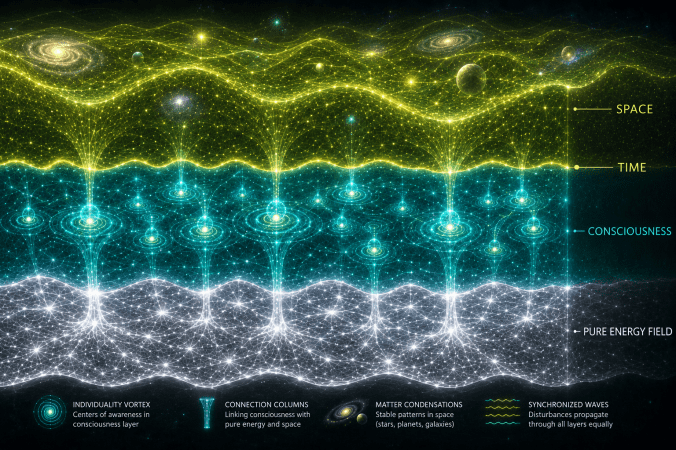
In this model, reality is composed of three interconnected layers:
- Pure Energy Field
- Consciousness
- Space
Time is not considered a separate layer. Instead, it emerges from the relationship between consciousness and space.
The purpose of this model is not to replace existing scientific theories but to provide a way of visualizing how consciousness, space, and time might be connected.
Important Note
The model presented in this article is a speculative philosophical framework intended to explore possible relationships between energy, consciousness, space, and time. It is not an established scientific theory, nor is it currently supported by direct empirical evidence. The purpose of the model is to provide a conceptual perspective that may stimulate reflection and discussion about the nature of reality.
The Three Layers of Reality
1. Pure Energy Field
The Pure Energy Field is the most fundamental layer in this model.
It exists beneath all other forms of reality and serves as the underlying foundation from which the higher layers emerge. It is not space, matter, or consciousness. Rather, it is the deepest level of existence represented within the framework.
An analogy would be the ocean beneath all waves. The waves may appear separate and distinct, but they ultimately arise from the same body of water.
In this model, the Pure Energy Field represents that underlying source.
2. Consciousness
Above the Pure Energy Field lies the layer of Consciousness.
This layer contains individual centres of awareness. In the accompanying diagram, these are represented as individuality vortices. Each vortex represents a distinct conscious perspective.
Although individual centres of awareness appear separate, they all remain connected to the same underlying Pure Energy Field.
The model proposes that consciousness acts as an intermediary layer between the fundamental energy field and physical reality.
An analogy can be found in whirlpools forming on the surface of an ocean. Each whirlpool appears distinct, yet all are expressions of the same water beneath.
3. Space
The upper layer represents Space.
This is the physical domain containing matter, stars, planets, galaxies, and all observable physical structures.
In this framework, physical objects are not considered the deepest level of reality. Instead, they are stable patterns that emerge within the space layer.
Just as waves form patterns on the surface of water, physical structures are viewed as patterns within space.
Time as an Interface
A central feature of this model is that time is not treated as an independent layer.
Instead, time exists at the boundary between consciousness and space.
According to this interpretation, consciousness experiences the physical world through its interaction with space. The experience of change occurs at this interface, and this experience is what we perceive as time.
Thus, time is not viewed as a separate substance or dimension but as a consequence of the relationship between consciousness and space.
The Experience of Change
An additional feature of this model is the idea that consciousness is continuously moving relative to space at the speed of light.
Because of this motion, consciousness continuously encounters new configurations of the space layer.
From this perspective, what we call the passage of time is actually the experience of consciousness encountering changing states of space.
A useful analogy is a movie projector.
A film contains many individual frames. If the film remains stationary, there is no apparent motion. Motion emerges only when the projector moves through the frames in sequence.
Similarly, in this model, space contains patterns and states, while consciousness experiences change by continuously moving through those states.
Another analogy is travelling along a road.
The road already exists, but the experience of the journey unfolds as one moves along it. Likewise, consciousness encounters successive configurations of space, creating the experience of past, present, and future.
In this interpretation:
- Space contains the patterns of physical reality.
- Consciousness is the experiencing layer.
- Time emerges from the interaction between consciousness and space.
- The flow of time results from consciousness continuously experiencing changing states of space.
When we observe a tree growing, watch a sunset, or experience our own thoughts, we are not directly experiencing time itself. Rather, we are experiencing changes in space as consciousness moves through them.
Relativity, Light Speed, and Time
This model also suggests a speculative interpretation of time dilation.
If consciousness normally moves relative to space at the speed of light, then anything that alters this relationship may also alter the experience of time.
From this perspective, the time dilation described by modern physics may reflect a change in the relationship between consciousness and space.
In everyday circumstances, consciousness continuously encounters new states of space, creating the familiar progression of moments. However, as motion approaches the speed of light, the relationship between consciousness and space may become increasingly altered.
As this relationship changes, the normal experience of temporal progression also changes.
Within this framework, time dilation is interpreted not simply as a property of spacetime, but as a modification in the relationship between consciousness and space.
The faster an observer moves through space, the more this relationship changes, and therefore the more the experience of time is affected.
At the theoretical limit of light speed, the distinction between successive spatial states may become increasingly compressed. In such a situation, the ordinary experience of temporal flow could lose its familiar meaning because the usual relationship between consciousness and space would be fundamentally altered.
The Connected Nature of Reality
The diagram accompanying this model shows synchronized waves moving through all three layers.
These waves symbolize the idea that reality is fundamentally interconnected.
Changes occurring within one layer may be reflected in the others. The Pure Energy Field, Consciousness, and Space are therefore not isolated domains but aspects of a single integrated reality.
The vertical connections shown in the diagram further suggest that each conscious centre remains linked both to the deeper energy field and to the physical universe.
In this way, consciousness serves as a bridge between the fundamental and the physical.
A Simple Everyday Example
Imagine that you decide to raise your hand.
Within this model, the process happens at the level of the Pure Energy Field. It also appears within Consciousness as an intention or awareness of action. Finally, it becomes expressed within Space as a physical movement of the body.
The entire process unfolds through the interface we call time, linking inner experience with physical change.
This example illustrates how the three layers may work together within a single event.
Conclusion
This layered model proposes that reality consists of three (or more) interconnected levels: a foundational Pure Energy Field, a layer of Consciousness, and the physical layer of Space.
Time is not treated as a separate entity but as the interface through which consciousness experiences changes within space.
According to this framework, the flow of time emerges from consciousness continuously encountering new configurations of space, while relativistic effects may reflect changes in the relationship between consciousness and space itself.
The model should be understood as a speculative philosophical interpretation rather than an established scientific theory. Its purpose is not to challenge existing scientific knowledge but to offer a conceptual framework through which questions concerning consciousness, space, time, and existence may be explored in a unified and accessible way.

